Gaussian Splatting in Houdini
End-to-end Gaussian Splatting framework built inside Houdini.
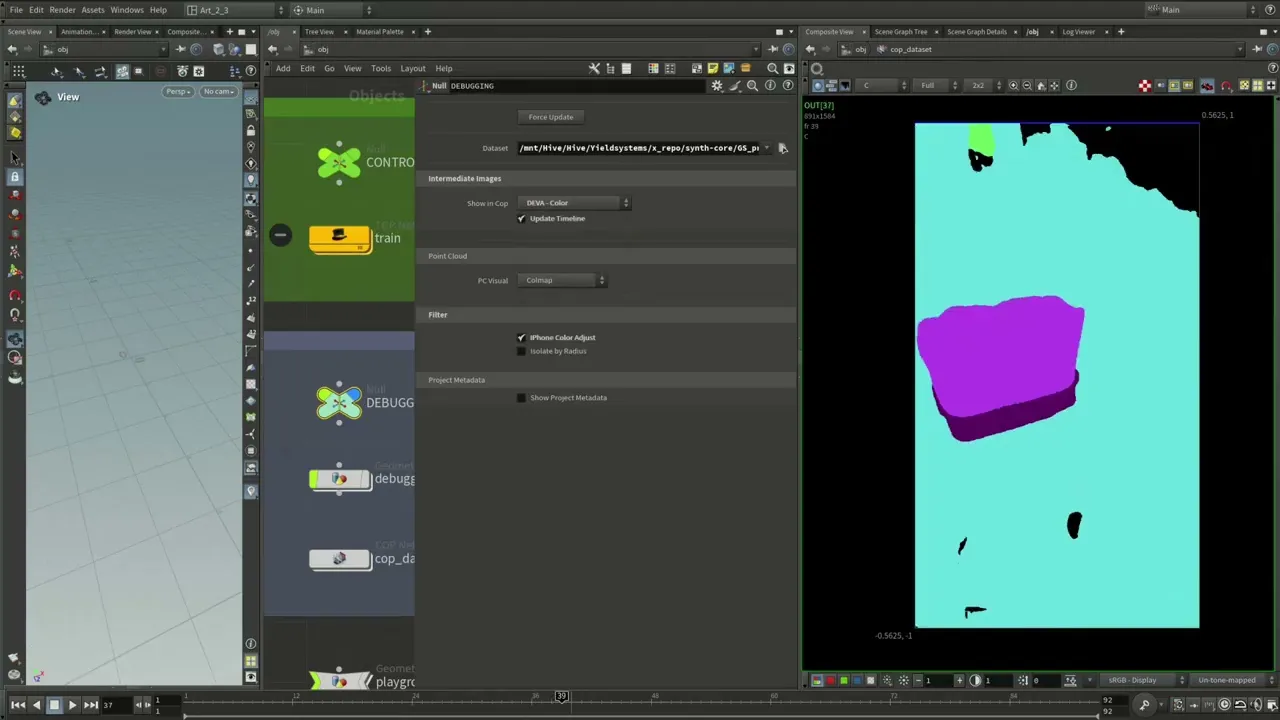
A Houdini-native framework for Gaussian Splatting. Every stage of the pipeline, from raw video through training and segmentation, runs inside Houdini and is orchestrated through TOP.
Self-contained: each stage produces inspectable intermediates. The trained splat is native Houdini geometry - composable with procedural geometry through standard SOPs.
Overview
- Houdini-native, TOP-orchestrated. Stages run as TOP work items, so batches scale.
- Per-gaussian semantics. Segmentation labels live as a per-gaussian attribute on a single splat. Queryable downstream by class without splitting the asset.
- Inspectable at every step. A debugging controller auto-updates as stages complete. Any iteration of the trained splat, the COLMAP point cloud, or the DEVA masks is readable from the graph.
- Splats as native geometry. Once trained, the splat is treated as point geometry carrying its splat attributes. Standard SOPs and the project's procedural toolkit apply.
How it works
Stages of the pipeline.
- Video to Stills. Source video is decomposed into frames.
- Filtering. Frames are pruned for quality and diversity before reconstruction.
- COLMAP. Structure-from-motion produces camera poses and a sparse point cloud.
- DEVA. Per-region masks are generated for semantic input.
- GS and Segmentation. Gaussian Splatting training, with segmentation labels attached at the per-gaussian level.
- Classifier and Style. Downstream operations on the trained splat. Class assignment and stylization.
What it enables
- Real-world captures brought into Houdini as procedural geometry, without leaving the app.
- Per-class or per-region splat outputs, ready as ground-truth or augmentation data for training.
- Hybrid scenes - procedural geometry composed with photogrammetric splats, handled uniformly by the same toolset.